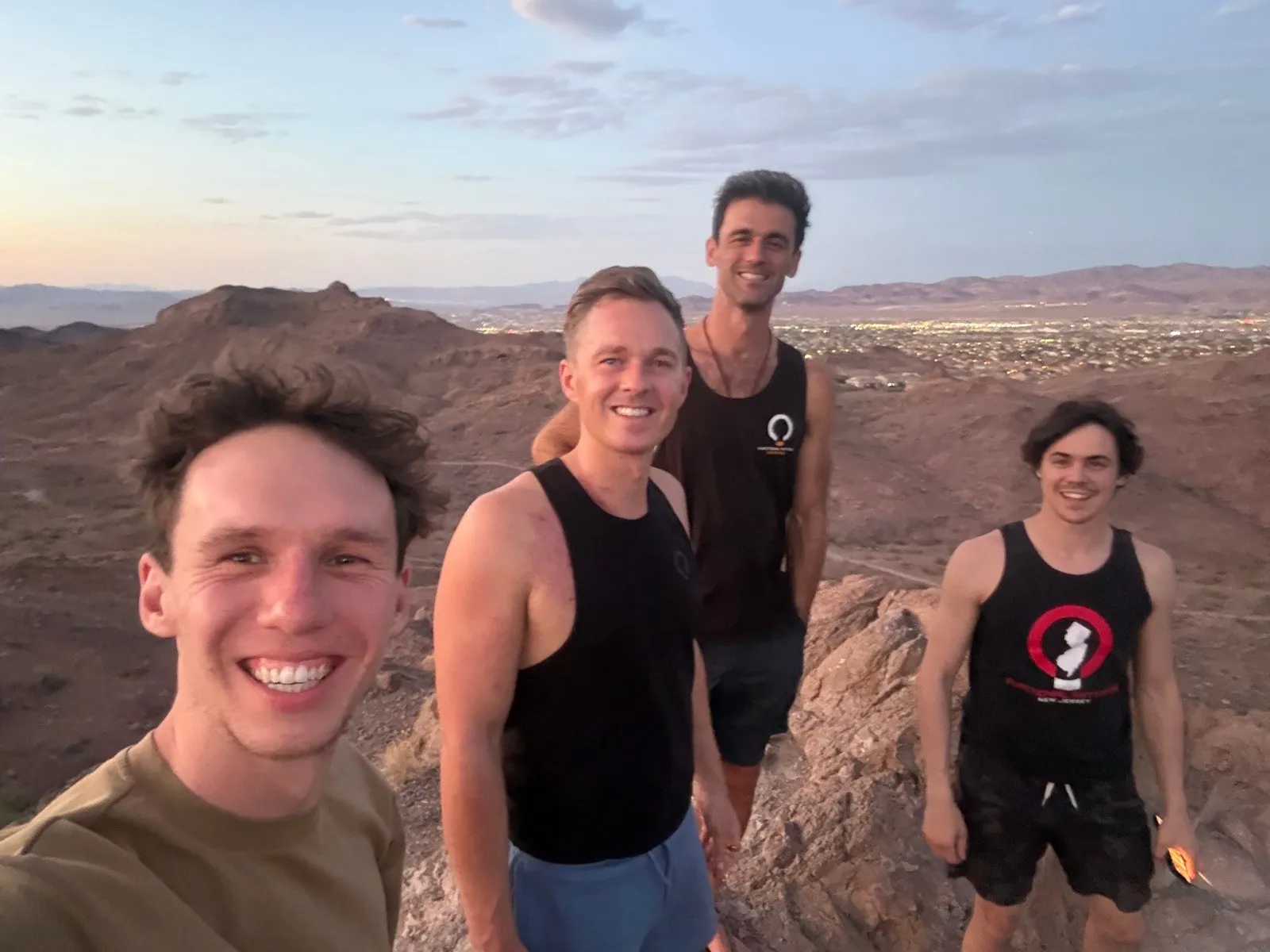
Michael Vincent (Melbourne) and Viktor Nikolovski (Syracuse), from the courses where we met.
We met at our first Human Biomechanics Specialist course, the HBS1: two strangers from opposite ends of the earth who’d stumbled onto the same training, and we ended up sharing accommodation for the week. We got on well enough to sit the HBS2 certification together, then went home to build practices about 16,000 kilometers apart. On opposite sides of the equator, in opposite seasons, neither of us bends the method to suit local tastes. We teach the same thing, the same way, because it works the same everywhere!
What actually makes it different
Most training treats the body as a collection of parts, a machine for this muscle and an exercise for that one. Functional Patterns starts from a different question: not “which muscle should we isolate?” but “how is this human supposed to move?” So rather than chase individual muscles, we train movement: the integrated, whole-body patterns you live in every day. Standing, walking, running, and throwing are the four foundational movements FP calls the Big 4, with breathing and gait underneath all of it.
You feel the difference in the room. You’re not counting reps on a leg press; you’re relearning how to stand over your own feet, how to breathe into a rib cage stacked where it belongs, and how to walk without leaking force into your lower back. It looks different and it feels different, and it carries into ordinary life the way isolated exercises rarely manage. Fix how someone walks and you’ve changed something they do ten thousand times a day.
Whether you’re standing upright in the north or down under in the south, gravity pulls the same way and your gait works the same way. A method that holds up on both sides of the planet is more than a trend. It’s a principle.
Why a method that travels matters
Functional Patterns was developed by Naudi Aguilar, who spent tens of thousands of hours training real people with disparate imbalances, and asking questions relative to his intense long hours of athletic film study. He developed a more granular process of training that accommodates human biology, simplifying a system into focusing on the functions of standing, walking, running, and throwing, and developing an ecosystem of correctives to precisely help any human being who was ready to commit to the process. He has helped the FP ecosystem of trainers tap into a kind of human biomechanical code that has allowed us to help regenerate the body as one moving system, whether one is 88 with a Parkinson’s diagnosis (see @fp.evidence or functionalpatterns.com), or 7-8 years young. As a global endeavor, it is built by certified practitioners all over the world: people who flew in from different countries to the same courses (that’s how we met), learned the same system, went home to completely different populations, and got the same kinds of results.
When a method only works for one gifted coach in one place, that’s a personality. When it works in Costa Mesa, Brunswick, Syracuse, Brisbane, Spain, Slovakia, Russia, India, Thailand (everywhere the courses land), that’s a method. Which brings us to the joke we can’t resist, because it’s also the point: it doesn’t matter whether you’re standing the right way up in New York or, from a globe’s view, hanging upside down in Melbourne. Same gravity, same gait cycle, same evolutionary design. The human blueprint doesn’t care which hemisphere you’re in, which is exactly why two coaches who grew up on opposite sides of the world can agree on every word of this.
Growing because it has substance
Functional Patterns is growing fast, with new courses, new facilities, and more Human Biomechanics Specialists every year. Plenty of fitness trends grow fast; most grow on marketing, peak, and quietly disappear. The ones that keep growing are built on something repeatable. When the growth comes from real results: people getting out of pain, moving better, and telling the people they care about, it feeds itself. We’re biased, obviously. But we each changed how we work because we watched this do things nothing in our old toolkits could.
We think it points to a real shift in how we understand health, away from chasing symptoms and toward training the body as the integrated, evolved system it is. Shifts like that reward the people who move early. You don’t have to take our word for it, though. Try it, feel the difference in a session or two, and decide for yourself.
If you’re near Syracuse, that’s where Viktor comes in. Start with an initial consultation, or read more about the methodology first. If you’re in Melbourne, Michael is a short search away. Wherever you’re standing on the globe, the invitation is the same: come see why the world is starting to move this way.
Michael Vincent is a Functional Patterns coach in Melbourne, Australia. He runs Michael Vincent PT and trains alongside the team at Functional Patterns Melbourne, having certified through the Human Biomechanics Specialist courses alongside Viktor.
Viktor Nikolovski is a certified Human Biomechanics Specialist (Functional Patterns Level 2) and the coach behind Syracuse Biomechanics, working with clients across Syracuse and Onondaga County, NY.